
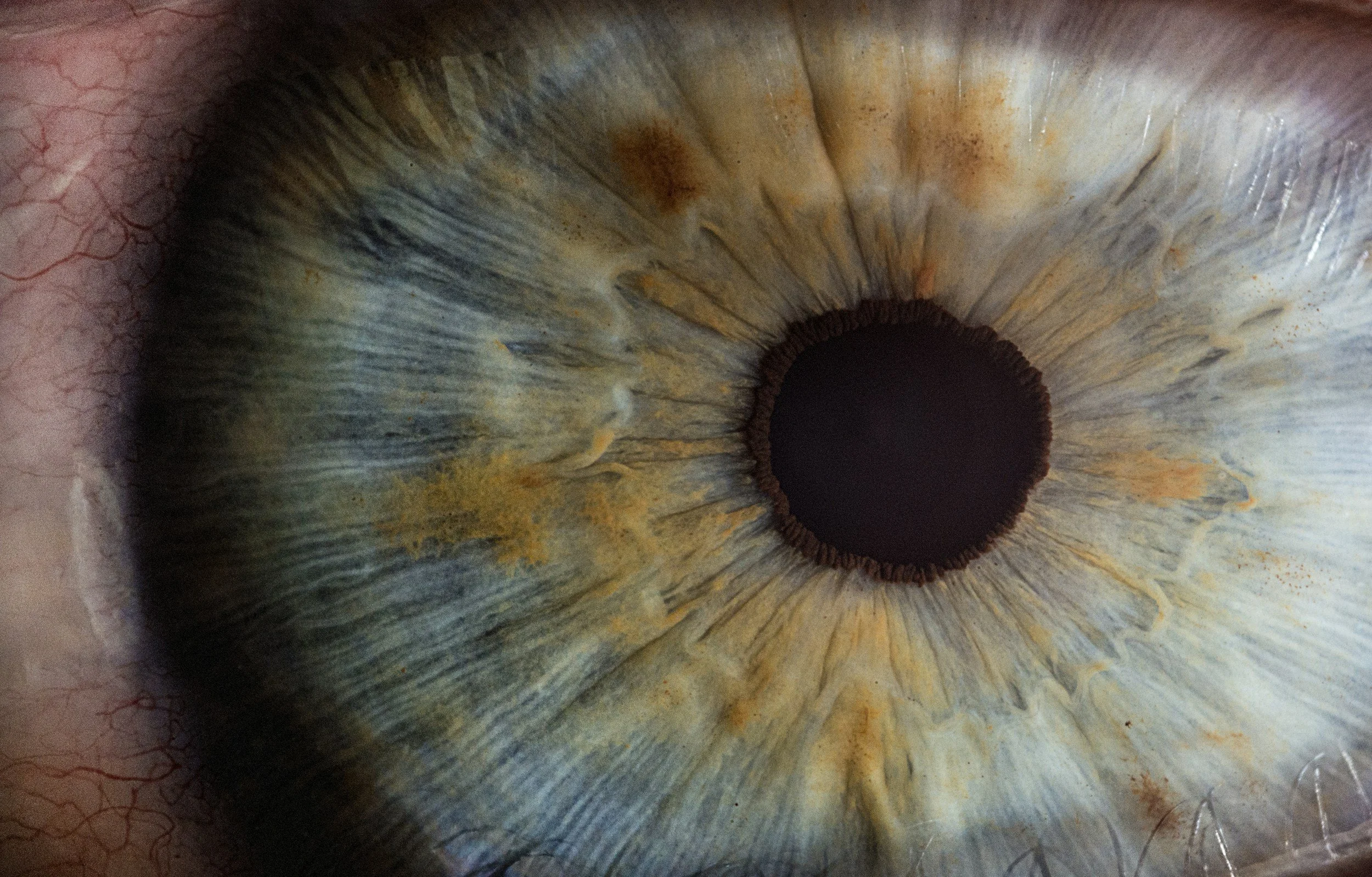
Ruptured Globe: When the outer covering of the eye (sclera) opens exposing the contents of the eye. This can be from a penetrating injury cutting the sclera or a blunt force causing the wall of the eye to rupture. Blunt trauma causing a rupture will usually be at the insertion of one of the extraocular muscles.
Repair of Ruptured Globe: Performed in an at-least two-step procedure, first the globe is closed to a water-tight original contour so that any nonviable tissue is excised and the wound is sutured closed; second, after about two weeks, a vitrectomy is performed with a repair of the retina, if possible. There may be further retinal surgeries as needed.
Visual Acuity: A Snellen visual acuity chart or projection is the standard test used to measure visual acuity. In the United States, vision is recorded at 20 feet. The largest letters are usually 20/400. If the patient cannot see the large letters, then the vision is recorded as count fingers (CF-X ft.) at the longest distance in feet. When the patient is unable to do so, the correct designation is hand motion (HM). If the eye cannot see hand motion, the next is light perception (LP). Finally, if the eye is unable to see any light, it is recorded as no light perception (NLP).
Vitrectomy: Removal of the vitreous (jelly inside the eye) along with any residual blood. This is essentially a clean-up of the inside of the eye to facilitate repair of the retina.
Phthisis Bulbi: A shrunken, nonfunctional eye. It may result from severe eye disease, inflammation, or injury, or it may represent a complication of eye surgery.
Sympathetic Ophthalmia (SO): A rare, bilateral, granulomatous uveitis (inflammation inside the eye) caused by exposure of previously immune-privileged ocular antigens from trauma or surgery with a subsequent bilateral autoimmune response to this tissue. The injured or operated eye is the exciting eye and the contralateral eye is the sympathizing eye. This can occur for many decades (potentially 20-30 years) after the initial injury
Ocular Prosthesis: An artificial eye or glass eye. These are types of craniofacial prostheses that replace an absent natural eye following an enucleation (removal of eye), evisceration (surgical removal of the contents of the eye leaving the sclera), or orbital exenteration (surgical removal of the eyeball and surrounding tissue). A prosthesis can also be fit over a phthisical (shrunken) globe. The prosthesis fits over an orbital implant and under the eyelids. Though often referred to as a glass eye, the ocular prosthesis roughly takes the shape of a convex shell and is made of medical grade plastic acrylic.
Stereopsis: Depth perception, which is the visual ability to perceive the world in three dimensions (3D)—length, width, and depth—which then allows a person to judge where an object is relative to him or her.
B-scan: An ultrasound of the eye showing the interior structures of the eye as well as the head of the optic nerve.